Hello, everyone!
I am Tapani Pelkonen, a man of Oulu who works in IT and sound.
For this site, I write stories mainly about sound-related experiences, but there may also be other stories.
On Liveside I mainly operate with Midas M32C mixer, mainly for its convenient size. If necessary, you can connect the X-touch controller to the set, if you need a little physicality, but the core control at Mixing Station is today and seems to be coming from the spine. I also own a full-size version of Behkun X32 if you need more physicism for a situation. Behkun Wing and Soundcraft Impact / Expression / Peform are also familiar, as are UI-series small mixers.
The software we know on the studio side is Logic and Reaper, although for the past 10 years I have mainly used Pro Tools.
Pro Tools has also been chained through more of the materials of the seftifications, but I have not completed the official certificate because of the salt price.

If you need to be in touch, either through the company's website audion.fi or by miles to one of these:
tapani.pelkonen (a) suuntakuvio.fi
tapani.pelkonen (a) audion.fi

Polar pattern?
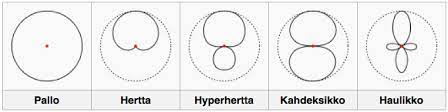
"There are different trends, but on the laws of physics Because they're all round. Polar pattern depends on the microphone Acoustic the policy, which in principle only consists of two: pressure sensitive and speed sensitive. The combination of these policies will enable all the directions shown below, except for the shotgun. The pattern of direction is mainly modified by leaving the back chamber of the film partially or completely open. The more directional the microphone Polar pattern (sweet patterns and conversions), the more the special feature of proximity is highlighted (engl. proximity effect). This means that when the microphone is really close to the sound source, such as: In the drum set, bass frequencies They become unnatural. The proximity signal is missing completely from the pressure microphone (sphere pattern). The ball microphone is also less sensitive to handling sound and wind.
Ball (engl. omnidirectional) is the oldest Polar pattern. Microphone with: Polar pattern is the ball, picks up the sounds from all directions equally strongly.
Hearts (engl. cardioid) is a so-called directional pattern, and the following two are its variations. A knockout microphone effectively picks up the sounds from the front and the sides, but leaves the voices coming from behind silent.
♪ Superpea ♪ (engl. supercardioid) is the first variation of a pea which: Polar pattern is narrower than the heart. Due to its technique, it also picks up some of the sounds coming from behind.
Hyperhertan (engl. hypercardioid) Polar pattern is even narrower, and it picks up the sounds coming from behind stronger than the superpea.
Eight (engl. bidirective, figure8) is according to its name Polar patternwhich picks up the sounds from the two opposite sides with the same intensity, and leaves the voices from the sides silent.
Shotgun (engl. Shotgun) is a microphone specifically designed for film and television production, which picks up accurately the sounds coming from the front (e.g., dialog, action) and slightly less from the rear and side (static sounds). "